Eight areas, twelve modules, one employee record. These are the capabilities HR managers in the region ask about most.
Compared
How Goose HR stacks upagainst the usual suspects.
Capability
Goose HR
Generic HR suite
Spreadsheets
Full Arabic interface and RTL layout
Partial
WPS SIF bank file export
Add-on
Manual
GPSSA contribution rules (UAE)
Manual
End-of-service gratuity accrual
Limited
Hijri holiday calendar and dual dates
Document expiry alerts
Add-on
Employee self-service portal
/ 01
Organisation
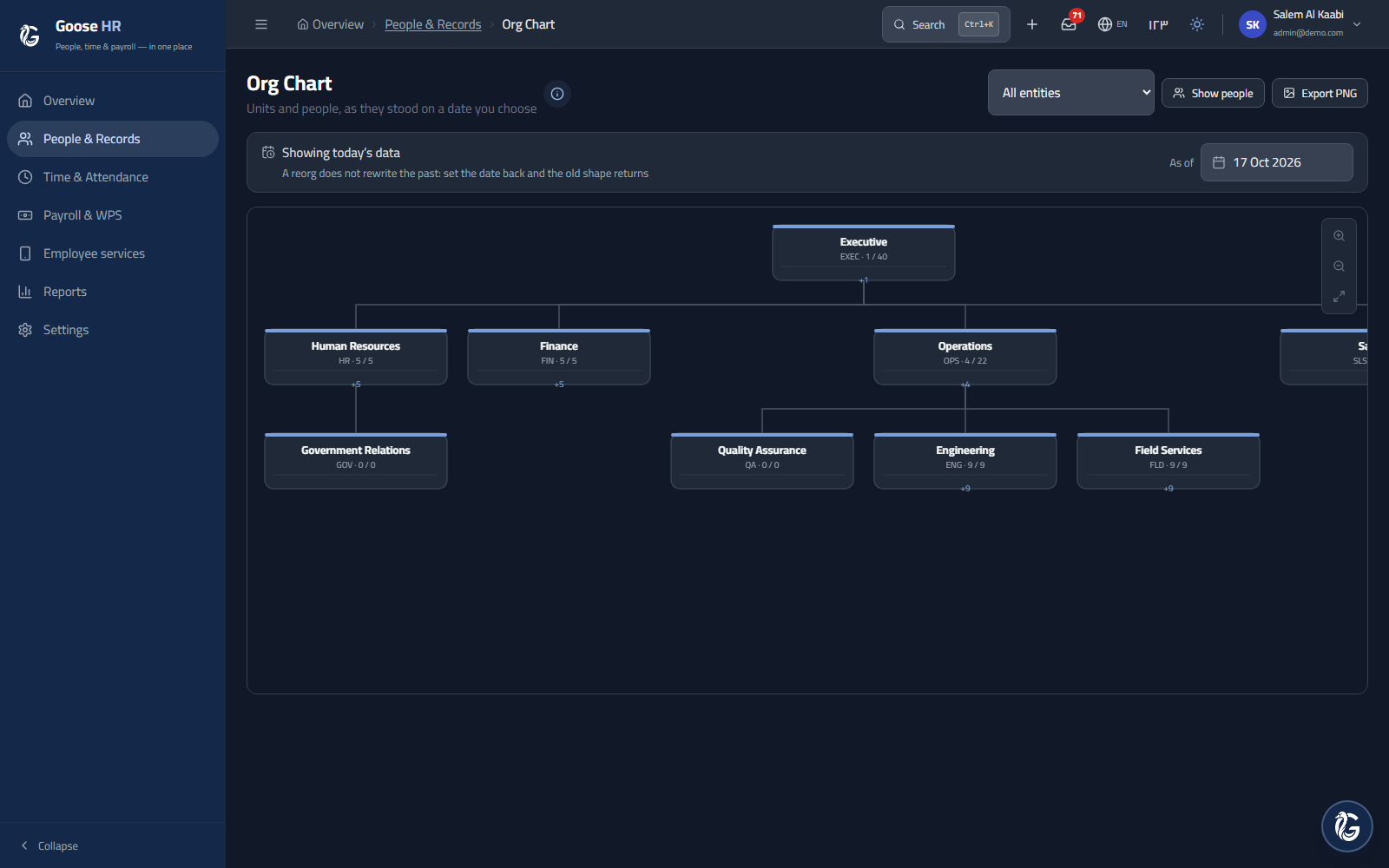
Multi-branch org chartsand real positions.
Model the company the way it actually runs: legal entities, branches in different countries, departments, and positions that exist whether or not someone is sitting in them. Every employee hangs off a position, so the chart, the headcount plan and the approval chain stay in sync.
Entities, branches, departments and cost centres
Positions with grades, bands and vacancy status
Reporting lines that drive every approval chain
Transfers, promotions and secondments with history
Multi-entityMulti-branchOrg chart
/ org / chart
/ 02
Documents
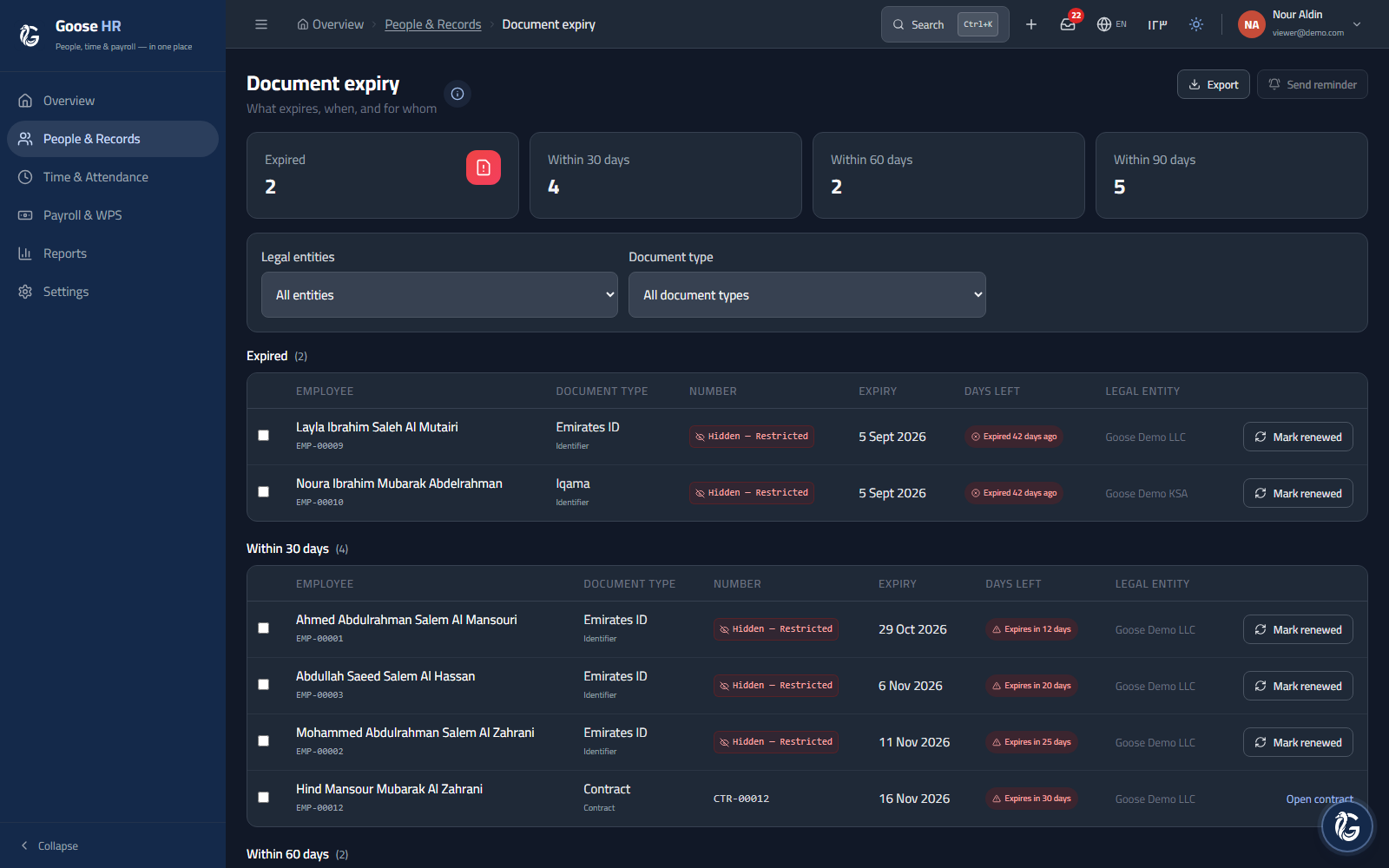
Expiry dates thatwarn you first.
Passports, residency permits, labour cards, health insurance, driving licences, professional certificates and contracts all live on the employee record with an issue date, an expiry date and an owner. Goose HR counts down and tells the right person before the deadline, not after.
Configurable alerts at 90, 60, 30 and 7 days
Scanned documents read by AI and filed to the right person, confirmed by a human
Company documents too: a register per legal entity
Full audit trail: who changed what, and when
Expiry alertsAI filingAudit trail
/ documents / expiries
/ 03
Leave & absence
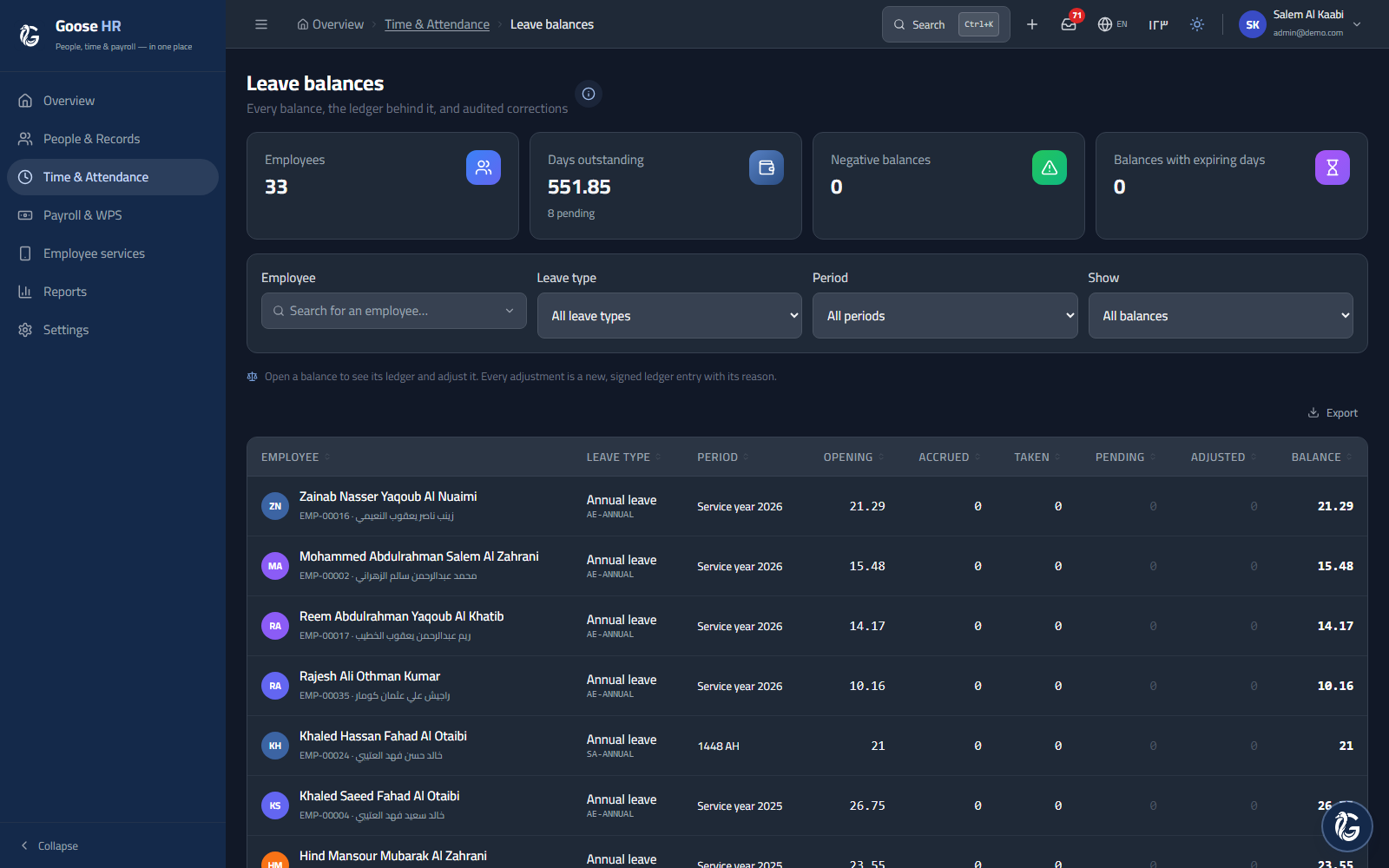
A leave engine thatdoes the arithmetic.
Define a policy once — accrual rate, waiting period, carry-over cap, encashment and whether weekends and public holidays count — and the balance takes care of itself. Hijri public holidays import straight into the holiday calendar.
Monthly or anniversary accrual, pro-rated on joining
Annual, sick, unpaid, maternity, paternity and Hajj types
Hijri public holidays imported into the calendar
Team calendar and leave liability report
AccrualsHijri calendarEncashment
/ leave / balances
/ 04
Time & attendance
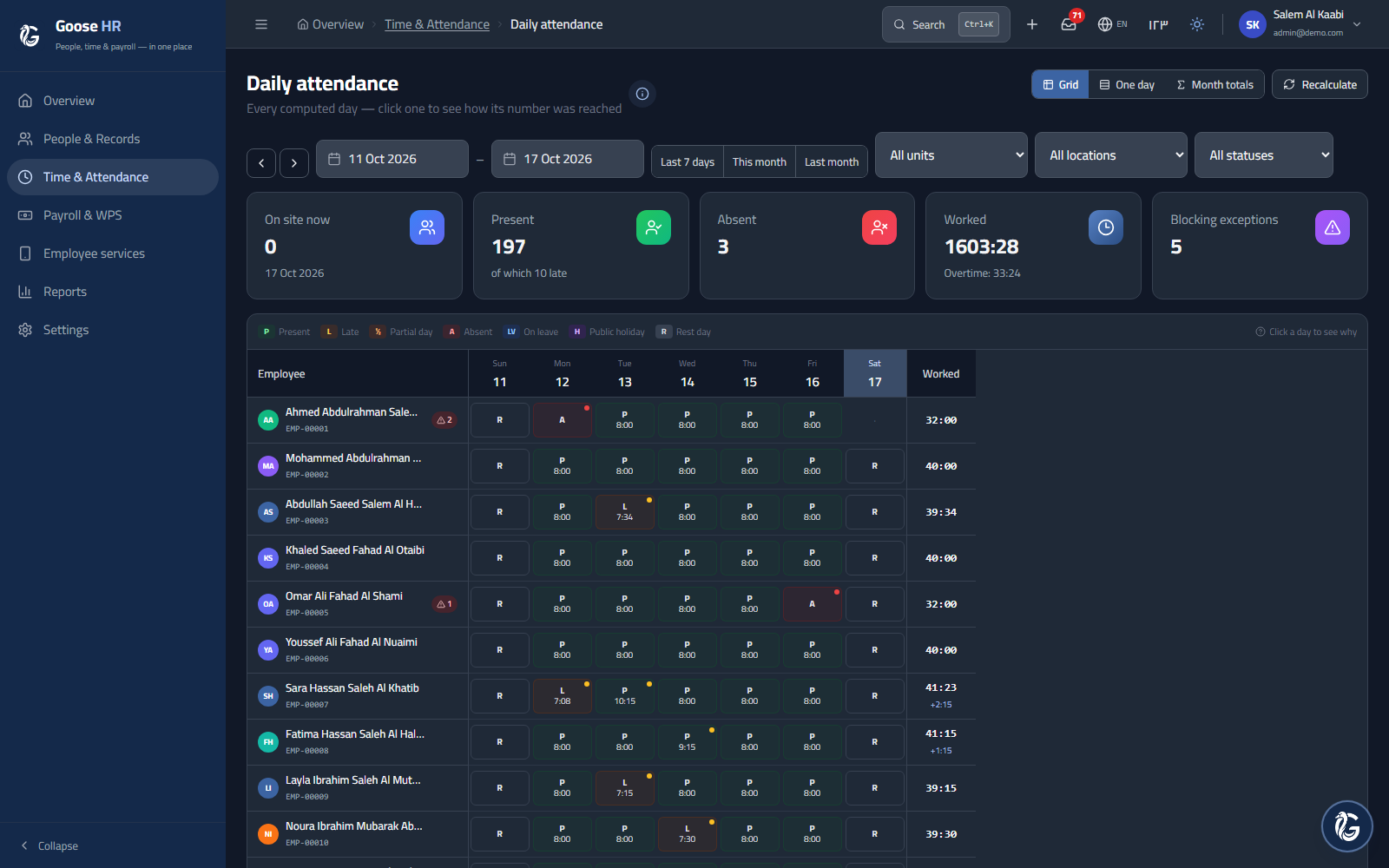
Geo clock-in, shiftsand honest overtime.
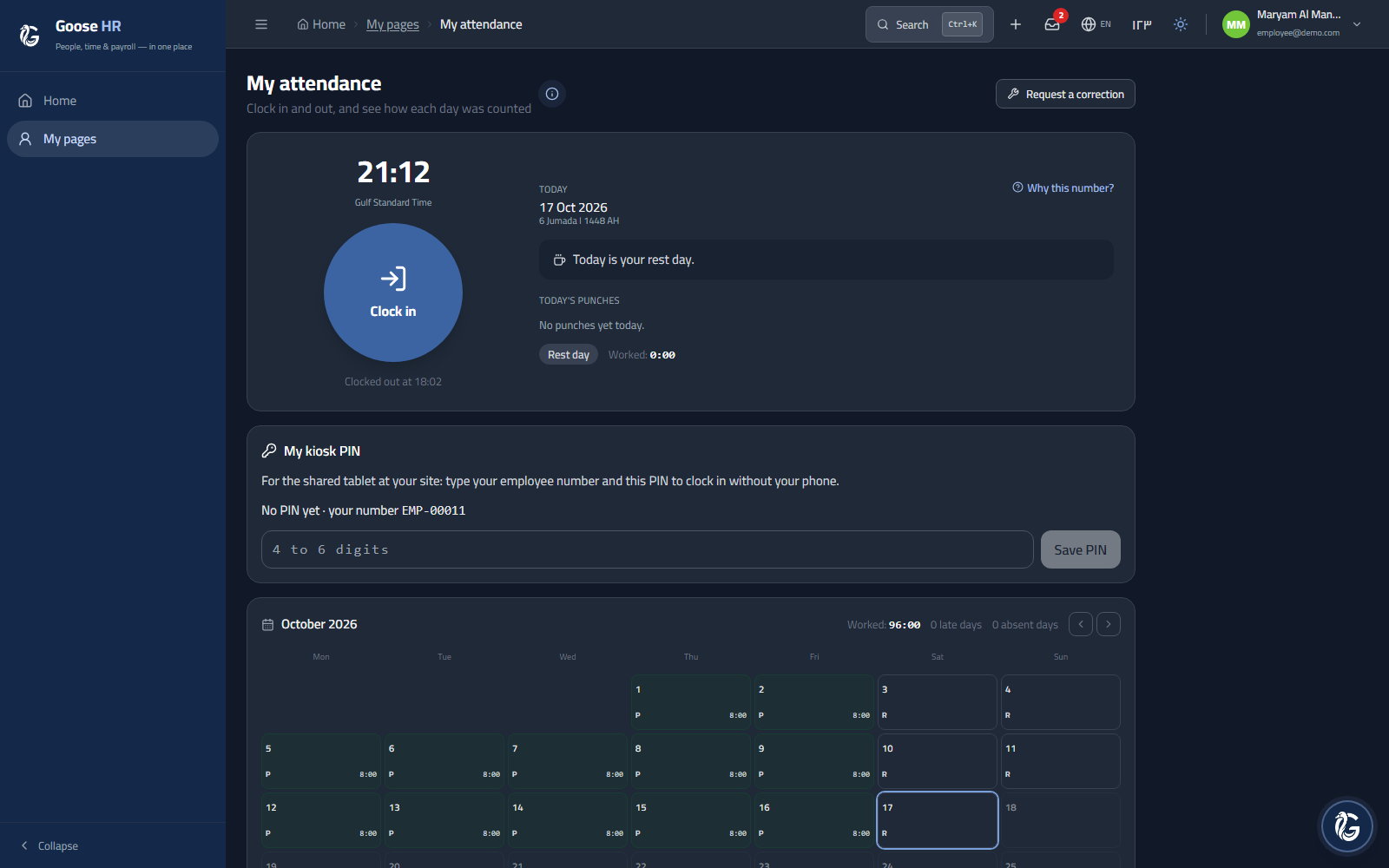
Staff clock in from a phone inside a geo-fence or through a registered attendance device. Shift patterns, grace periods, break rules and overtime multipliers are configured per branch — and the resulting timesheet is what payroll reads.
Geo-fenced clock-in from a phone
Fixed, rotating and split shifts, plus Ramadan hours
Late, early-out, absence and overtime rules per policy
Punch import from registered devices, and manual corrections
Geo-fenceShiftsTimesheets
/ attendance / daily
/ 05
Payroll
WPS, social insuranceand gratuity, calculated.
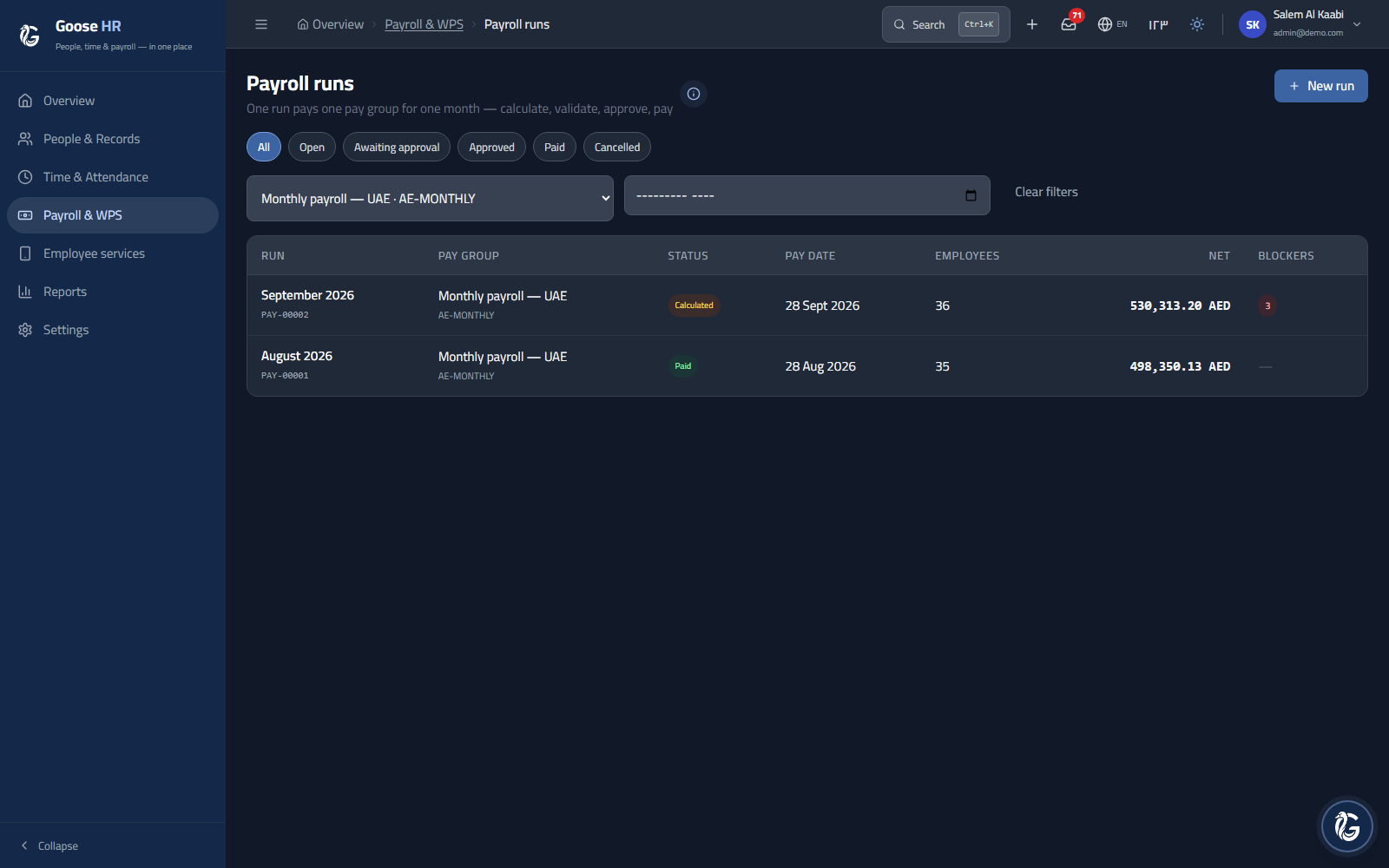
One run pulls the approved timesheet, leave without pay, loans and allowances, then applies the UAE's rules: GPSSA contributions and end-of-service gratuity accrued month by month. You review a variance report, approve, and export the WPS SIF file. Saudi Arabia's GOSI rules are in validation.
WPS SIF export, validated before you upload it
GPSSA contribution rules by nationality
End-of-service gratuity accrued and settled correctly
Payslips, loan deductions and off-cycle runs
WPS SIFGPSSAGratuity
/ payroll / runs
/ 06
Self-service
Employees and managersanswer their own questions.
Most of the HR inbox is four questions: how much leave do I have left, where is my payslip, what is my end of service worth, and who approves this. Goose HR answers all four in the employee's portal, in the employee's language, and tells the manager only what they need to decide.
Leave balance, request and team calendar in two taps
Payslips to view and print, and an end-of-service estimate
Leave requests and resignations that route for approval
Manager view: my team, their leave, their requests
Installs on any phoneBilingualManager view
/ attendance / me
/ 07
Approvals & workflows
Requests that routethemselves.
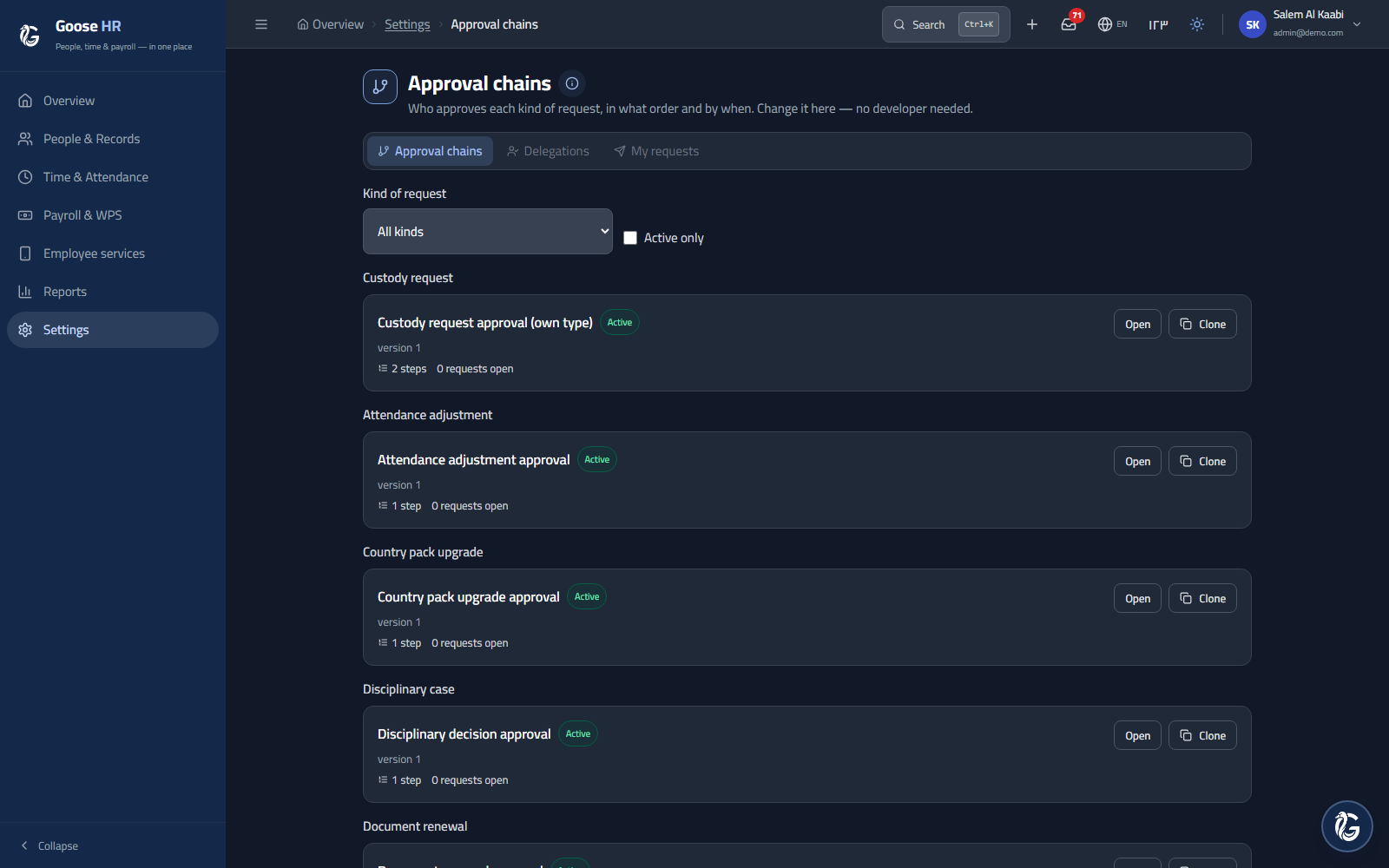
Every request type — leave, overtime, letters, expense claims, resignations and terminations — follows an approval chain: who approves, in what order, above which amount, and what happens when someone is away. Nothing waits on a forwarded email. Chains are built without code, and each new version is simulated before it goes live.
Multi-step chains, including by amount
Automatic delegation while an approver is on leave
Escalation and reminders when a step goes stale
One inbox for everything awaiting a decision
ChainsDelegationEscalation
/ workflow / definitions
/ 08
HR dashboard
Headcount, expiriesand what is waiting.
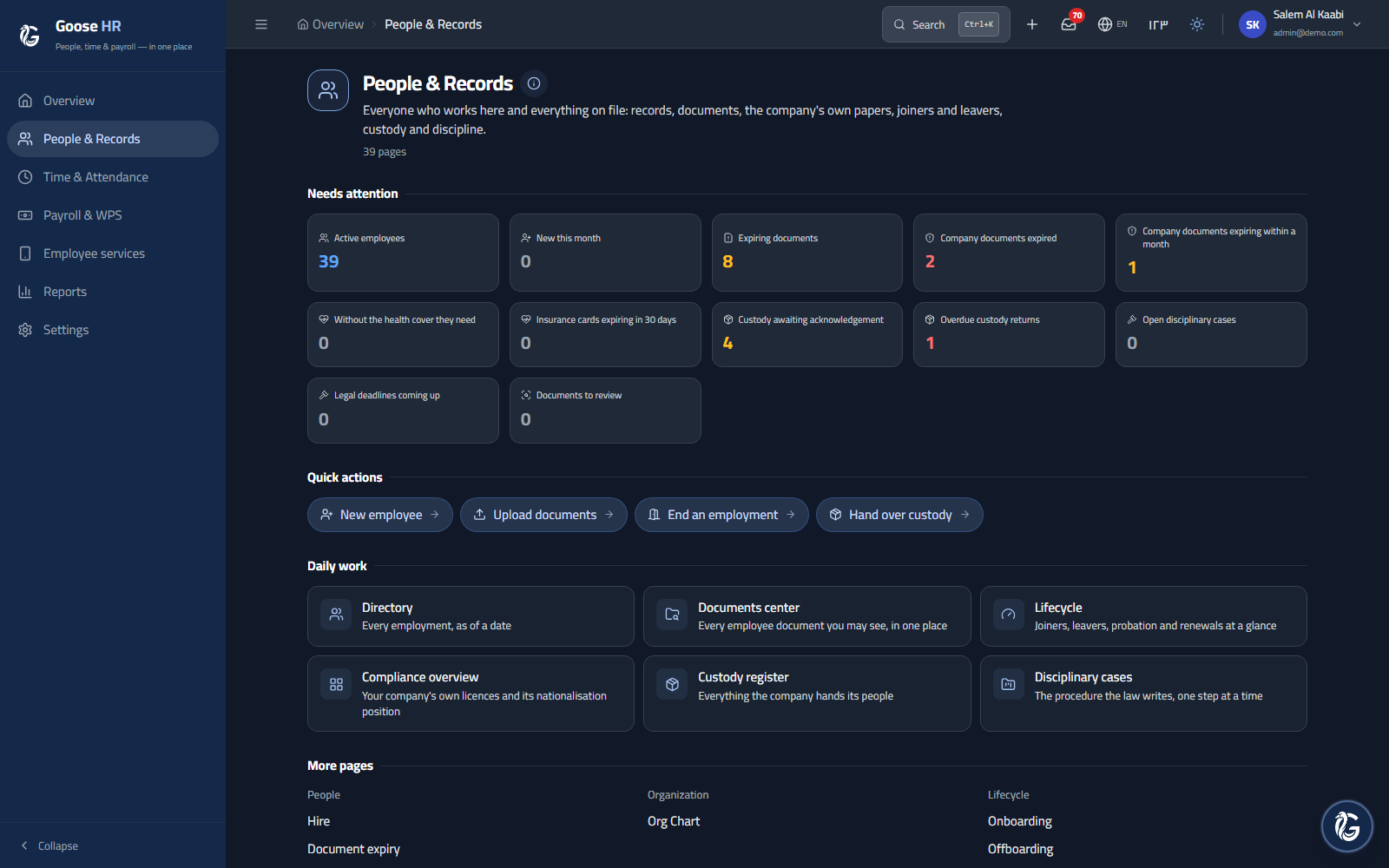
The HR dashboard shows headcount by department, the documents about to expire, the dates coming up and the leave and attendance picture, computed from the records when you open it. Turnover, tenure and workforce-cost analytics are coming.
Headcount by department, live from the records
Documents expiring in the next 90 days
Leave liability export for finance
Turnover and workforce-cost analytics — coming
HeadcountExpiriesLiabilities
/ section / people
Everything else
The full listof capabilities.
/ 01
Employee record
Personal, contract, bank, dependants and emergency details — bilingual, versioned, with an effective date on every change.
/ 02
Letters & certificates
Service, employment and salary certificates, travel NOCs and your own templates, in Arabic and English, generated as PDF with a QR code that verifies them.
/ 03
Leave policies
Accrual rules, waiting periods, carry-over caps, encashment and half-days — assigned by grade, branch or contract.
/ 04
Shift planning
Rotating rosters generated ahead of the week, with Ramadan variants and overtime caps.
/ 05
Salary structures
Basic, housing, transport and custom components, with grades, bands and a clear history of every revision.
/ 06
Loans & advances
Loan and advance deductions inside the payroll run. A loan register with instalment schedules is coming.
/ 07
Performance cycles
Goals, check-ins, self and manager reviews and calibration — coming soon.
/ 08
Onboarding checklists
Tasks split across HR, IT and the hiring manager, with assets issued, accounts created and nothing forgotten.
/ 09
Offboarding & settlement
Notice period, clearance, asset return and a final settlement that includes gratuity and unused leave.
/ 10
Roles & permissions
Granular permissions per module and action, a row scope that shows managers only their own team, and sensitive fields masked by tier.
/ 11
Notifications
In-app alerts for approvals, expiring documents, probation end dates and payroll deadlines. E-mail delivery is coming.
/ 12
API & integrations
The REST API behind every screen, and CSV import through validated, approved jobs. Export covers core HR data today; full export is coming.
Ready when you are
See it with your own employee list.
Book a demo and bring a spreadsheet: we will show you how your own employee list comes in.